Showing posts with label Cycle B. Show all posts

Cycle B Christ the King

 Dan 7:13-14; Rev 1:5-8; Jn 18:3-37

The contemporaries of Jesus grew up hearing the stories of the cruelty of the ancient kings and rulers. Biblical Accounts give vivid descriptions of the cruelty of the Assyrians. In 722 BC Assyrian armies swept through the Near East. They became notorious for their cruelty.  There are caves in Palestine to this day where we can find etched into cave-walls depictions of Assyrian cruelty: men beheaded, children disembowelled, pregnant women ripped open. The Assyrians did it. Up until the Assyrian assault there had been twelve tribes in Israel. The Assyrians slew ten. After 722 BCE there were only two tribes left, Judah and Benjamin. The other ten will never be seen again.


The kings of Assyria tormented the miserable world. They flung away the bodies of soldiers like so much clay; they made pyramids of human heads;  they burned cities;  they filled populous lands with death and devastation;  they reddened broad deserts with carnage of warriors;  they scattered whole countries with the corpses of their defenders as with chaff;  they impaled

Cycle B 33rd Sunday in Ordinary Time

Dan. 12:1-3; Heb. 10:11-14, 18: Mk. 13:24-32

The passage from Mark 13:24-32 draws our attention to two profound truths: the certainty of the end and the uncertainty of its timing. It reminds us of the transient nature of creation and the permanence of God’s word. Jesus’ apocalyptic vision, filled with vivid imagery of cosmic upheaval, challenges us to reflect on our readiness for that day. Today, we will explore these themes, drawing support from the Old Testament, other religious traditions, and examples from both ancient and contemporary times. Ultimately, we are called to live lives of vigilance, rooted in faith, hope, and love.

Jesus begins with striking imagery: the sun darkened, the moon withholding its light, and stars falling from the sky. This description underscores the inevitability of cosmic upheaval, echoing the Old

Cycle B 32nd Sunday in Ordinary Time

 1 Kgs 17:10-16; Heb. 9:24-28; Mk. 12:38-44

Todays Gospel passage gives us two messages. 

In the first  section, Jesus warns against the scribes, who represent the religious elite of the time. These scribes wore long robes, relished greetings of respect in public spaces, and sought prominent seats at gatherings. However, Jesus reveals that their intentions are corrupted by selfishness and pride. They exploit the vulnerable, such as widows, using long, public prayers as a display of piety rather than genuine worship. His message to the crowd and His disciples is to beware of such hypocrisy, as those who misuse their position of spiritual authority will face greater judgment.

In the Old Testament, we encounter figures who, like the scribes, misused their positions of power. Hophni and Phinehas, the sons of Eli the priest, serve as tragic examples of leaders who abused their positions of authority. As priests in the house of the Lord at Shiloh, Hophni and  Phinehas were entrusted with leadingthe people

Cycle B 31st Sunday in Ordinary Time

Deut 6:2-6; Heb 7:22-28; Mk 12:28-34.


The central message of today's readings is the most fundamental principle of all religions. It is to love God in loving others and to love others in loving God.

In history we find thousands of people who have manifested their love for God even by sacrificing their lives.

On 3 June 1886, thirty-two young men, pages of the court of King Mwanga of Buganda, were burned to death at Namugongo for their refusal to renounce Christianity. In the following months many other Christians throughout the country died by spear or fire for their faith.

Initially, the young Kabacka had been impressed by Christianity: He liked what he saw and heard of the Christian message, and he also recognized that his people would benefit from the education and skills that the missionaries had brought with them.

Cycle B 30th Sunday in Ordinary Time

 Jer. 31:7-9; Heb.5:1-6; Mk. 10:46-52

The Persistent Faith of Bartimaeus

In the account of Bartimaeus, we find a story that is both a powerful illustration of faith and a profound challenge to the spiritually "blind." Bartimaeus, a blind beggar on the outskirts of Jericho, catches wind of Jesus passing by. He cries out with conviction, "Jesus, Son of David, have mercy on me!" Despite the crowd's attempts to silence him, Bartimaeus calls even louder, determined to reach the one he believes can restore his sight. The crowd's reaction serves as a metaphor for the spiritual forces that try to suppress genuine faith and hope. But Bartimaeus is unrelenting. His faith is not only in Jesus' ability to heal but also in Jesus' compassionate mercy.

When Jesus stops and calls him forward, Bartimaeus leaves behind his cloak—a valuable possession for a beggar, symbolizing his comfort zone and security. By shedding it, he shows his readiness to embrace whatever Jesus has to offer him, showing faith

Cycle B 29th Sunday in Ordinary Time

 Is 53:10-11; Heb 4:14-16; Mk 10:35-45

Today's Gospel places before us two beautiful themes. The trust and confidence of James and John, the sons of Zabedee, in the glory of Jesus and the teaching of Jesus to be practiced in his kingdom to attain glory.

James and John, the sons of Zabedee, approached Jesus with a request: "Master, allow us to sit one at your right hand and the other at your left in your glory. James and John witnessed many times the opposition that Jesus faced from the religious leaders; they experienced the bitterness of the clergy against Jesus; they sensed the dangers that awaited Jesus on his way ahead; in spite of them all they could still connect glory with a Galilean carpenter. This is an amazing confidence and loyalty.


The challenges James and John had continued to be the challenges of every Christian in every age, but they made their appearance in their contemporary forms – like challenges of dogmas, challenges raised by philosophies, challenges caused by

Cycle B 28th Sunday in Ordinary Time

 Wisdom 7:7-11; Hebrews 4:12-13; Mark 10:17-30

Today’s Gospel passage from Mark 10:17-30 speaks of the Cost of Discipleship and the Challenge of Wealth. In this passage a rich man approaches Jesus, asking what he must do to inherit eternal life. His question is genuine, and he has lived a righteous life, following the commandments. Yet when Jesus calls him to deeper sacrifice—selling his possessions and giving to the poor—the man goes away sorrowful. Jesus then teaches his disciples about the difficulty of entering God's kingdom, particularly for those attached to wealth.

The challenge of wealth and attachment can be found in the Old Testament. Consider the story of King Solomon (1 Kings 11:1-11). Initially blessed with wisdom and wealth, Solomon’s heart gradually turns away from God because of his attachment to his riches and foreign wives. Though he started with a vocation as a wise ruler, his love for wealth and power caused him to lose his focus on God. He becomes an example of someone who, though gifted, strayed from his calling due to material attachments.

Another example is Lot's wife (Genesis 19:26). When God commanded Lot’s family to flee from Sodom without looking back, Lot’s wife couldn’t resist turning her gaze back to the life she was leaving. Her attachment to her past life, possibly her

Cycle B 27th Sunday in Ordinary Time

Gen 2:18-24; Heb 2:9-11; Mk 10:2-16

Marriage has been a mystery throughout human history. From the time immemorial philosophers have reflected on this mystery, poets have sung about it, and religious men have glorified it. They realized that marriage is a union of man and woman in physical, mental, religious and social realms.

In their attempt to give a convincing explanation for this mystery the wise men of the ancient past gave rise to many legends. According to a Greek legend,” The original human nature was not like the present, but different.  The sexes were not two, as they are now, but originally the man and woman were together.  The primeval man was called Androgyne. He was round, his back and sides forming a circle; one head with two faces looking in opposite ways, set on a round neck and

Cycle B 26th Sunday in Ordinary Time

 Numb. 11:25-29; Jas. 5:1-6; Mk. 9:38-43, 45, 47-48

The conflict between good and evil is one of the precepts of the Zoroastrian faith, first enshrined by Zarathustra over 3000 years ago. It is also one of the most common conventional themes in literature, and is sometimes considered to be a universal part of the human condition.

In the Bible this battle has been vividly explained by the story Kain and Abel. Kain becomes filled with jealousy and kills his brother.

There is a battle going on in the lives of each of us, a battle between good and evil. At the end of that battle we will either hear Jesus say, "you are mine" or “Go away." Through his cross Jesus has won the battle but it is up to us now to accept his grace and live as those redeemed by Jesus. There are manifestations of grace and manifestations of evil all around us but we can take the side of Jesus in the battle for our lives by overcoming sin and temptation.

How do we overcome sin and temptation? In the Gospel Jesus said, "if your hand should cause you to sin cut it off; it is better for you to enter into life crippled than to have two hands and go to hell… if your foot should cause you to sin

Cycle B 25th Sunday in Ordinary Time

Wis. 2:12, 17-20; Jas. 3:16-4:3; Mk. 9:30-37

One of the causes of suffering in the world is that the godless ones applied human wisdom in the planning of their evil deeds. There are many stories in the Bible that explains this theme.

 Genesis 37 tells us the story of the Plot Against Joseph. Joseph’s brothers were filled with jealousy when they saw their father’s special love for him and heard about Joseph’s dreams of future greatness. Instead of seeking reconciliation or understanding, they plotted to get rid of him. Using deceit and cunning, they initially planned to kill Joseph but later sold him into slavery, deceiving their father by dipping his coat in blood. This act of cruelty was fueled by human wisdom twisted by envy, as they sought to eliminate the one who threatened their sense of importance.

In 2 Samuel 15 we read about the Conspiracy of Absalom. Absalom, King David’s son, plotted to usurp his father’s throne by employing shrewd political maneuvering. He strategically positioned himself at the city gates, winning the favor of the people by pretending to care for their grievances. Through deception and

Cycle B 24th Sunday in Ordinary Time

 Is. 50:5-9; Jas. 2:14-18; Mk. 8:27-35

In Mark 8:27-35, Jesus asks His disciples the crucial question, “Who do people say that I am?” The responses show a variety of opinions, identifying Jesus with John the Baptist, Elijah, or one of the prophets. But the pivotal moment comes when He directs the question to His disciples: “But who do you say that I am?” This is not just a question of theological identity; it is a call to personal conviction.

Jesus then shifts the conversation, calling both the disciples and the crowd to an even more challenging teaching: “Whoever wants to become my follower, let him deny himself and take up his cross and follow me.” This is not an easy message, yet it lies at the heart of the Christian journey—sacrifice, self-denial, and following Christ even when it leads to suffering. In the modern world, where we are encouraged to focus on self-promotion, wealth, and comfort, this call might seem radical.

There are many examples  of self-denial and sacrifice they had to make while they were in search of God. Moses’ entire life is a testimony of sacrifice and self-denial. He gave up a life of comfort and privilege as a prince in Egypt to identify with the

Cycle B 23rd Sunday in Ordinary Time

Is. 35:4-7; Jas. 2:1-5; Mk. 7:31-37

The healing of the deaf man with the speech impediment, as described in Mark 7:31-37, is a powerful demonstration of Jesus' compassionate touch and transformative power. This event not only shows Jesus’ ability to heal physically but also symbolizes the opening of hearts, minds, and lives to the fullness of God’s grace. 

The context of this miracle is significant. Jesus had been ministering in the predominantly Gentile region of Decapolis, a place where Greek culture and pagan beliefs were prevalent. The man brought to Jesus was both deaf and had a speech impediment, conditions that not only isolated him from society but also hindered his ability to fully express himself. In the ancient world, physical ailments were often seen as divine punishment, and people with disabilities were frequently marginalized.

The man’s friends brought him to Jesus, begging Him to heal their companion. This act of intercession reflects a deep faith in Jesus' ability to heal and a desire for the man’s restoration to society. Jesus, in His characteristic compassion, responds to their

Cycle B 22nd Sunday in Ordinary Time

Deut. 4:1-2, 6-8; Jas. 1:17-18, 21-22, 27; Mk. 7:1-8, 14-15, 21-23

During today's First Reading, we heard that Moses gave the commandments of the Lord to His people and told them to pay attention to the statutes and ordinances so they may live, enter and occupy the promised land.

As God's chosen leader of the people, Moses explained to the Israelites that by diligently observing the commandments of the Lord, they would be showing an example to the surrounding nations who worshipped false gods and sacrificed children to their gods. When those nations would hear of the spiritual laws of the true God, they would say, God's people are wise and discerning.

The Pharisees were deeply committed to preserving the Jewish law, and over time, this commitment expanded into a complex system of traditions meant to safeguard the law’s purity. Washing hands, cups, and utensils were part of this tradition. It was an effort to remain holy in a world they saw as defiled by sin. 

In today’s Gospel passage, Mark 7:1-8, 14-15, 21-23, we encounter a moment of profound teaching from Jesus. The Pharisees and scribes, the religious leaders of the time, approach Jesus with a complaint. They notice that some of

Cycle B 21st Sunday in Ordinary Time

 Jos 24:1-2, 15-18; Eph 5:21-32; Jn 6:60-69

In today's first reading we see the challenge that Joshua set before his people. He assembled all the people at Shechem and threw a challenge before them: to follow Yahweh or to choose the gods they liked. Shechem has been a holy place for the Israelites since ancient times. It was at Shechem that God had appeared to Abraham and promised him that one day, that land would belong to his descendants (Gen 12:6-8). It was at Shechem that Jacob bought a piece of land, erected an altar (Gen 33:18-20) and ordered Rachel and all his family to bury the idols they had brought with them (Gen 35:4-5). It was at Shechem that the bones of Joseph, brought from Egypt, were buried (Joshua 24:32). This was the very same place that Joshua chose to challenge the Israelites to be faithful to Yahweh (Joshua 24:14-15). This is near the site of Jacob's well, where Jesus spoke with the Samaritan woman (John 4).

In today's Gospel we see the challenge that Jesus places before the people who gathered to listen to him. After listening to the teachings of Jesus many of them remarked, "This is intolerable language. How could anyone accept it?" 

Cycle B 20th Sunday in Ordinary Time

Prov. 9:1-6; Ephes. 5:15-20; Jn. 6:51-58

In the Gospel of John, Jesus declares, "I am the living bread that came down from heaven. Whoever eats of this bread will live forever; and the bread that I will give for the life of the world is my flesh" (John 6:51). This profound statement is a cornerstone of Christian faith, encapsulating the mystery of the Eucharist and the intimate relationship between Christ and His followers. To fully grasp the depth of this teaching, we must explore its roots in the Old Testament and its fulfillment in the New Testament.

The concept of bread as a divine gift is deeply rooted in the Old Testament. In Exodus, God provides manna from heaven to sustain the Israelites during their journey through the wilderness (Exodus 16:4-35). Manna was more than just physical nourishment; it was a symbol of God’s providence and care for His people. This daily bread was a reminder of the Israelites' dependence on God and His constant presence in their lives.

Cycle B 19th Sunday in Ordinary Time

1 Kgs. 19:4-8; Ephes. 4:30-5:2; Jn. 6:41-51

We often overlook the most profound blessings in our lives simply because they are familiar. This is a theme that resonates deeply in today’s Gospel reading. Here we see people dismissing Jesus' divine nature because they were too familiar with His earthly origins. "Is not this Jesus, the son of Joseph, whose father and mother we know? How can he now say, 'I have come down from heaven?'" Their familiarity with Jesus' family and background blinded them to the extraordinary truth He was revealing.

 This tendency to undervalue the familiar is a human condition that spans the biblical narrative too. The story of Joseph and his brothers in Genesis is a powerful example of how familiarity can lead to a failure to appreciate God's work in someone's life. Joseph's brothers were envious of the special attention he received from their father, Jacob, and were further aggravated by Joseph's dreams, which

Cycle B 18th Sunday in Ordinary Time

 Ex. 16:2-4, 12-15, 31a; Ephes. 4:17, 20-24; Jn. 6:24-35

In John 6:24-35, we witness a profound dialogue between Jesus and the crowd, a discourse that transcends the physical act of feeding to reveal a deeper spiritual truth. This passage invites us to look beyond our immediate needs and desires, to seek the eternal sustenance that only Christ can provide.

Today's First Reading from the sixteen Chapter in the Book of Exodus [Ex. 16:2-4, 12-15, 31a] made reference to a very well known event, the raining of bread from Heaven. Exodus 16:4-5: The story of manna in the wilderness is pivotal in understanding this passage. Just as God provided manna to the Israelites, Jesus is now offering the true bread from heaven.

Another passage from Isaiah 55:2, also echoes Jesus' call to seek the food that endures for eternal life.  "Why spend money on what is not bread, and your labor on what does not satisfy? Listen, listen to me, and eat what is good, and you will delight in the richest of fare." 

Cycle B 17th Sunday in Ordinary Time

2 Kgs 4:42-44; Ephes. 4:1-6; Jn. 6:1-15

During today's First Reading, [2 Kgs. 4:42-44] we heard that a man brought food from the first fruits to Elisha, the man of God. This generosity was in obedience to the word of God to His people through Moses. The Lord said, "The choicest of the first fruits of your ground you shall bring into the house of the Lord your God." [Exo. 23:19]

The theme of sharing God's provision is seen throughout the Bible. Consider the story of Elijah and the widow of Zarephath (1 Kings 17:8-16). During a severe drought, Elijah asked a widow for some water and a piece of bread. Though she had only a handful of flour and a little oil, she shared it with Elijah, and her supplies miraculously lasted until the drought ended.

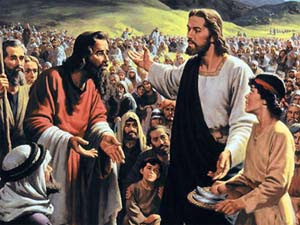
Today's Reading from the Gospel of John [Jn. 6:1-15] reminds us of the multiplication of the food, how five barley loaves and two fish fed five thousand persons while leaving twelve baskets of leftovers.

Cycle B 16th Sunday in Ordinary Time

Jer. 23:1-6; Ephes. 2:13-18; Mk. 6:30-34

During today's First Reading, we heard the promise of God the Father to gather the remnant of His flock out of all the lands and to raise shepherds over them to shepherd them. Throughout history we have seen the fulfilment of this Divine prophecy. Our loving and merciful heavenly Father also promised that through the genealogy of King David, He would raise a righteous Branch, He who would reign as King and deal wisely, and he would execute justice and righteousness in the land. Through Him who will be called our righteousness, the people from every nation would qualify to be saved. This has been fulfilled through Jesus. And Jesus continues his Mission through the Disciples.

Today, we reflect on a profound passage from the Gospel of Mark, where we see the apostles returning from their mission, exhausted and in need of rest. Jesus, recognizing their need, invites them to retreat to a deserted place. Yet, even in their attempt

Cycle B 15th Sunday in Ordinary Time

 Amos 7:12-15; Ephes. 1:3-14; Mk. 6:7-13

Today's readings from the Holy Gospel echo that we have all been called by the Lord. Each has a calling according to the Divine Will of God. Each and everyone of us have been commissioned through Jesus Christ to lead a life worthy of adoption to become children of God.

During today's First Reading from the Book of Amos we heard that the Lord told Amos, "Go, prophesy to my people Israel." As you heard from this reading and previous biblical readings, in those days, "in many and various ways God spoke of old to our father by the prophets." Each prophet received a distinct commission according to his calling.

The Prophets remained faithful to their mission but many a time they were not welcomed. As we heard from the First Reading, the Word of God through Amos was not welcomed. Amos was told to go somewhere else to prophesy.

Today’s Gospel tells us how Jesus sent out his disciples with a mission. "Jesus called the twelve and began to send them out two